
How to make a plan that works. Why planning in quarters works better than planning a whole year?
There are many core concepts that allow for a more structured and sustainable career. One of the essentials is… planning.
I don’t know about you, but I used to set goals for the year, feel motivated for a week or two, and then slowly lose track of what I was actually working toward. Either I planned too much and couldn’t keep up, or I kept things so vague that nothing really moved forward.
And it wasn’t until I started working at a startup that I realized planning is a whole skill, and so much of your success depends on it.
From small projects with hard deadlines to thinking about the company’s long-term direction, everything needed to be supported by a solid plan.
Planning in quarters
Working at the startup, with its fast-paced but highly efficient environment, taught me one very important lesson: planning in quarters makes much more sense than planning a whole year.
A year is just… too long. You either overplan and abandon it, or underplan and it stays too vague and impossible to execute. And how could we expect our situation to stay the same throughout a full 12-month period? You learn something new, new opportunities show up and shift your priorities or maybe you even have to pivot.
A 3-month period feels different because it’s long enough to make real progress, but short enough to adjust when things change or start again without feeling like you’ve failed some bigger plan.
What quarterly planning helps you with:
It gives you better feedback
In a year-long plan, you might not realize for 6–9 months that something isn’t working. In a 3-month cycle, you find out much faster. Quarters let you adjust without feeling like you “failed the plan.”
It reduces overwhelm and decision fatigue
A full year of goals often turns into a long list of “things I will do someday.” A quarter forces a constraint because you start asking what matters right now, and it helps you avoid choosing too many directions at once.
Having that natural deadline at the end of the quarter gives you a push to meet your own internal timeline.
It saves you from burning out
I don’t think anyone has stable motivation across 12 months. You naturally go through phases of increased focus, lower energy, exploration, and… doubt. If you work in 3-month periods, it’s easier to notice when you’ve just gone through an intense one. It’s okay to take the first week of the new quarter off.
The last thing you want is to burn out.
It turns vague ideas into achievable milestones
A yearly goal often stays too abstract. If you take something like “I want to grow my audience,” “finish my portfolio,” or “sell my work,” it’s hard to know what you actually need to do. They’re just too vague. But when you plan in quarters, you can turn it into something like: “In the next 3 months, I’ll publish three new portfolio pieces.”
Now it’s something observable, and you can actually mark it as done.
It allows you to change direction
A yearly plan assumes you should know what you want for 12 months, but let’s be honest here, creative work doesn’t really work like that. Quarterly planning lets you test ideas without committing all your energy to something you’d have to keep up with for a full year.
And after 3 months, you can reassess without guilt!
Try it yourself
I know planning can feel overwhelming, but if you want to try it, you can keep it really simple, you don’t need a perfect system just yet.
Just take a pen and a piece of paper and think about the next 3 months. What would you like to have finished by then?
I’m sure there’s a lot coming to mind right now, but try to isolate one main thing. Think of something that would actually feel like a success to you. Why one thing? You want to start simple. Great planning is a skill you learn as you go (or likely learn best by failing once or twice…)
Now, note down everything you need to do to achieve it from start to finish.
Let’s say you want to build your website portfolio, if you don’t have one yet. Let’s assume you already have all the artwork you want to upload, so it’s all about actually publishing the website.
What’s the first step?
It’s choosing a platform. Now, you could go into an endless loop of researching the best (or cheapest) option, which is valid, but what if you gave yourself a deadline instead?
By the end of week 1 of your new quarter, you need to have the platform chosen. No excuses.
Now you’ve taken the first step, and that’s huge already because you can move to the next step.
Next, take another week (or a few days, if that’s enough) to get familiar with the platform. Realistically, how many pages do you need? I think the Gallery page, About section and Contact page are more than enough for your first version. That’s three pages to design.
How about you start with the gallery page? That’s the easiest one, right? Just upload the artwork you already have.
You see where I’m getting with this?
Clear steps, the easiest possible decisions, a sense of progression marked by the deadlines you met… And before the quarter ends, you might have something that didn’t exist before which is your own website portfolio!
Maybe something you might have been trying to build for a long time?
How about you?
What’s your experience with planning? Do you feel it’s something you should improve, or are you doing well already? I’d love to hear about your experience.
Until next time,
Mila
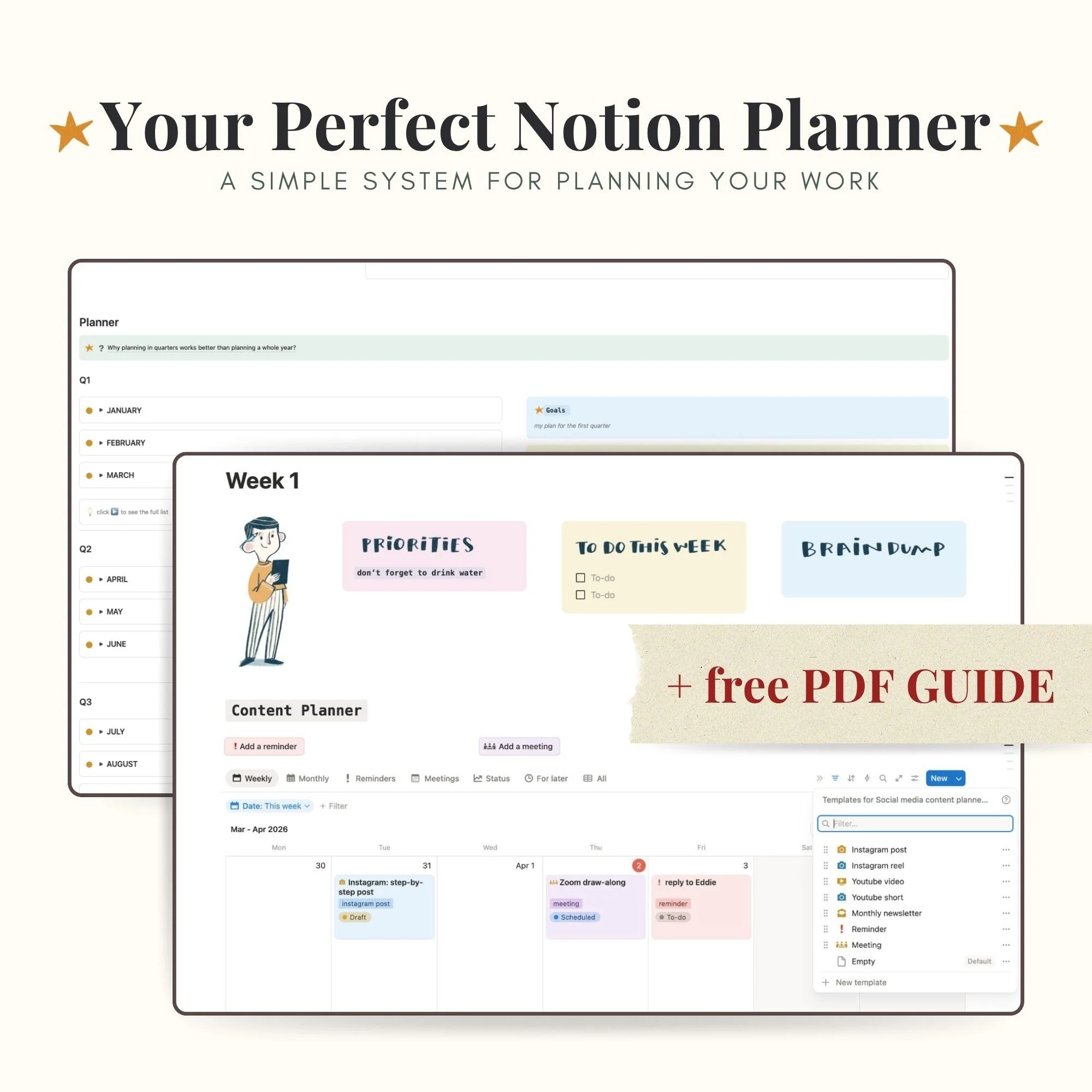
PS. I don’t want to sound too sales’y, but if you need help with planning your quarters, maybe my Notion planner could help? Like all my resources, it comes with a guide showing you how to set it up and use it.
Or maybe you’re using it already and want to share your experience? I’d love to know!
Who this is for
This will probably work well for you if:
– you’re an artist or creative trying to stay consistent
– you like having some structure, but not too much
– you want something that supports your work, not controls it
What this planner helps you do:
Instead of juggling ideas, tasks, and plans in your head (or across five different apps), this gives you one place to:
– plan your current quarter without overthinking it
– organize your weekly and monthly content
– break bigger goals into smaller, doable steps using the Creative Roadmap template
– keep track of ideas for later (without losing them)
What’s inside
The planner is built around sections that work together:
Quarter planning
A place to map out what you want to focus on over the next three months
Weekly planner
With your day-to-day and where things actually get done
Priority and to-do list system
Flexible enough to move things around when plans change (because they will)
Future ideas
For all the “not now, but later” thoughts
Creative Roadmap by Milena Milak
A stand-alone template where you can plan your projects, bigger and small
Free PDF guide included
If Notion ever felt confusing or overwhelming, this part is for you!
You’ll also get a step-by-step PDF guide that walks you through:
– how to set up the planner
– how to use each section
– how to use the quarterly planning system